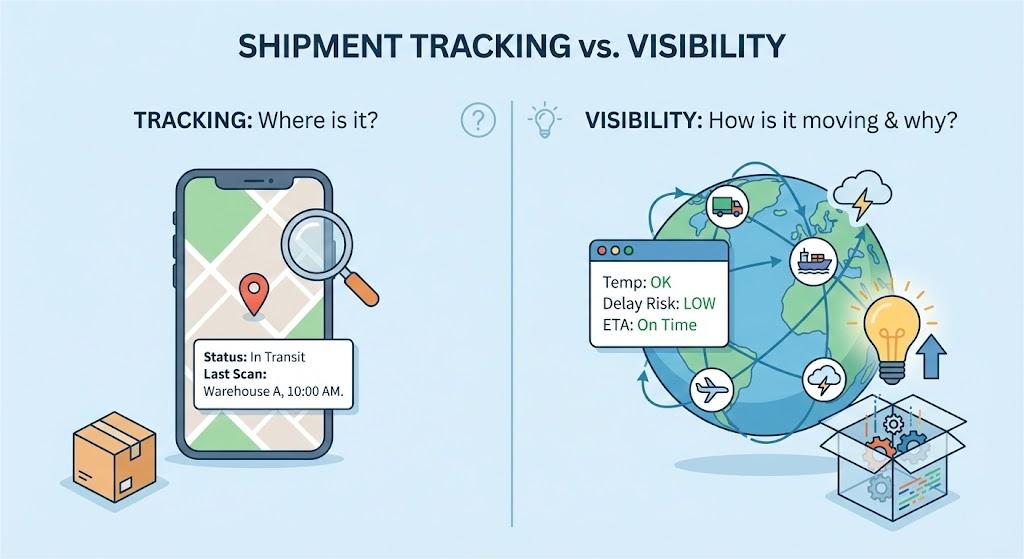
In the world of ecommerce, transparency is the key to conversion.
A clear Estimated Time of Arrival (ETA) gives shoppers the confidence to finally click “Place Order”. Because it sets the right expectations for package arrival, it also minimizes the flood of WISMO (Where Is My Order) queries during shipping.
But there is a problem. Since most ETAs are calculated only when the order is placed, they are static. They rarely update, even when routes or conditions change. This gap leads to customer disappointment and makes your operations chaotic.
In this article, we’ll explain everything about ETAs and why moving to accurate and dynamic estimates is essential for your store.
What Is the Estimated Time of Arrival (ETA)?
The estimated time of arrival (or ETA) is the predicted time a shipment or package will reach a customer’s doorstep in ecommerce shipping.
In logistics, it can also refer to the estimated time a shipment arrives at the local hub or port, which usually means the package is about to enter the last-mile delivery stage.
What Is the Estimated Time of Departure (ETD)?
The estimated time of departure is when a shipping carrier (truck, van, or vessel) leaves a warehouse, port, or airport with your products. It helps everyone involved coordinate their tasks and meet deadlines, so the shipment leaves on schedule.
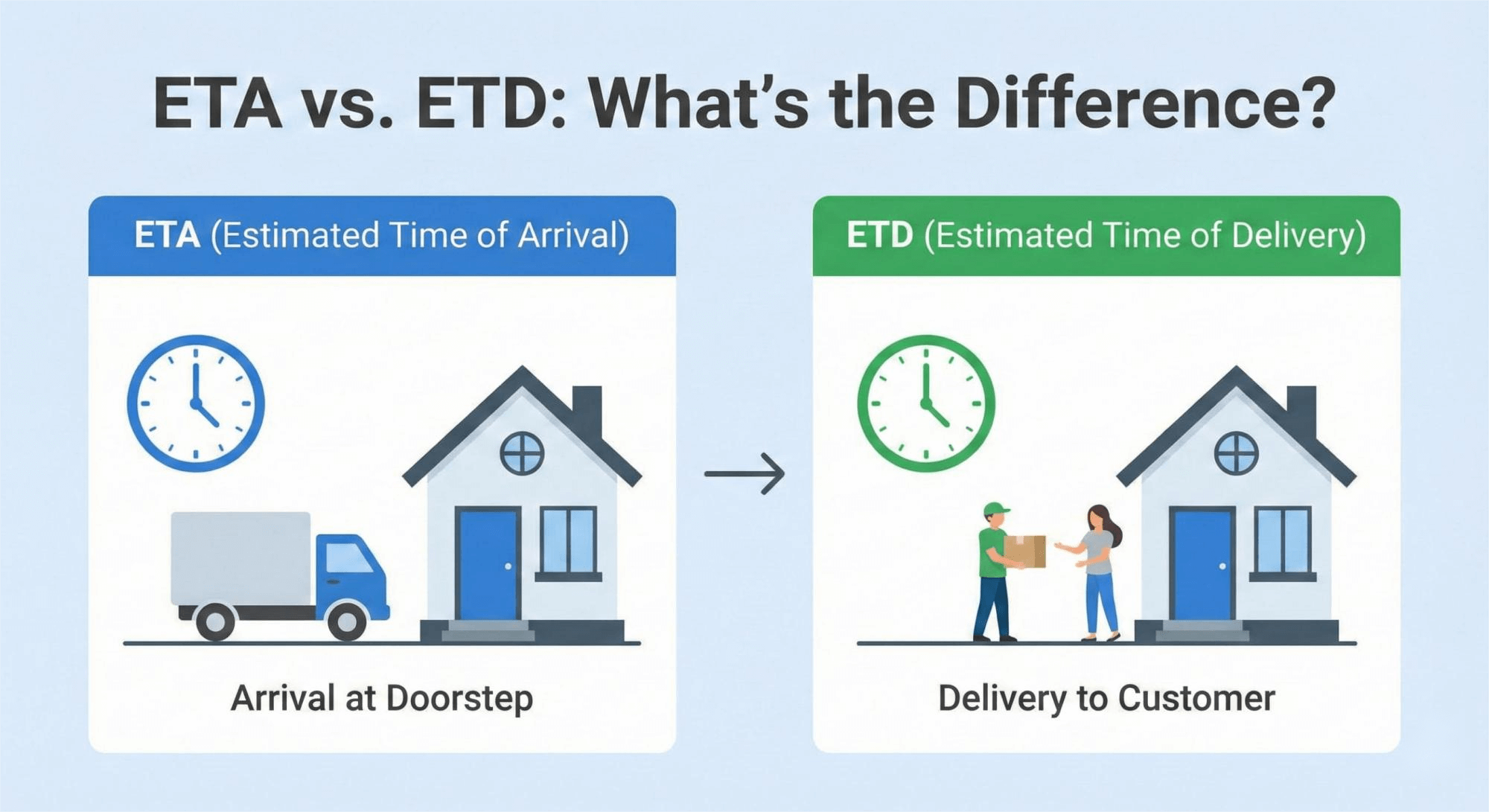
Other than being the “departure time,” ETD also stands for “estimated time of delivery.” The estimated time of delivery is when the package actually gets to your customer’s door, not when it leaves your facility.
Estimated Time of Arrival vs. Estimated Time of Delivery
You might think that ETA and ETD (estimated time of delivery) are the same because of our definition above. But there’s a slight difference in meaning you should know of.
ETA tells you when the carrier pulls up to the address, while ETD is the “actual time” the package is handed over to the customer or receiving party.
Here’s an example: Imagine that the delivery vehicle reaches your customer’s place at 3:00 PM. Since it’s a multi-story building, the courier has to find a parking space, enter the building, ride the elevator, and (of course) ring the doorbell of the right unit. When the package reaches your customer’s hands, it’s already 3:20 PM.
As you can see, there’s a 20-minute “window” between the courier’s arrival time (3:00 PM) and the product’s delivery time (3:20 PM).
How to Calculate Estimated Time of Arrival
You need these three pieces of data to calculate the estimated time of arrival: the current time, the distance to the destination, and the vehicle’s average speed. Once you gather that info, you can use it with this formula:
ETA = Current time + (Distance ÷ Average speed)
Let’s say that the vehicle (for this one, let’s use a truck) needs to cover 240 miles from your warehouse to a regional sorting facility. It averages 50 mph on that route.
- 240 miles ÷ 50 mph = 4.8 hours (or 4 hours 48 minutes)
- If the shipping carrier leaves at 9:00 AM, you just have to add 4 hours and 48 minutes.
- The ETA will be 1:48 PM.
But here’s the thing: this standard ETA may not be accurate most of the time. That’s because of the factors that affect the travel time, and we’ll discuss them next.
Factors That Affect Estimated Time of Arrival
The estimated time of arrival gets affected by external factors, which means the actual delivery time might not match what was predicted. Here are the factors that affect how accurate your ETA is:
- Weather or climate conditions: If there’s a storm coming (whether it’s a blizzard or typhoon), you have to expect delays that might last for hours… or even days.
- Road conditions and routes: Highway routes are way faster than city routes, as rush-hour traffic and stoplights are more common there. But, you also have to think of possible “accidents” and construction on whatever road you take.
- Loading and unloading delays: Port congestion and backlogs from other shipments (caused by busy seasons) can also make pickups and drop-offs take way longer than you planned.
- Customs and inspections: This is more common if you’re shipping internationally. Customs can hold your package anywhere from a few hours to multiple days.
- Human factors: These are “short” breaks like rest stops and meal breaks, but they can still add 30 minutes to an hour onto your total transit time.
- Mode of transportation: Your shipment can be by air, land, or sea, and it’s important to know that each one moves at different speeds (and faces different delays).
ETA calculators often rely on historical data and current conditions, so they may miss sudden delays that happen during transit. To get the most accurate prediction, you need to factor in all of these potential variables.
Planned vs Dynamic ETA
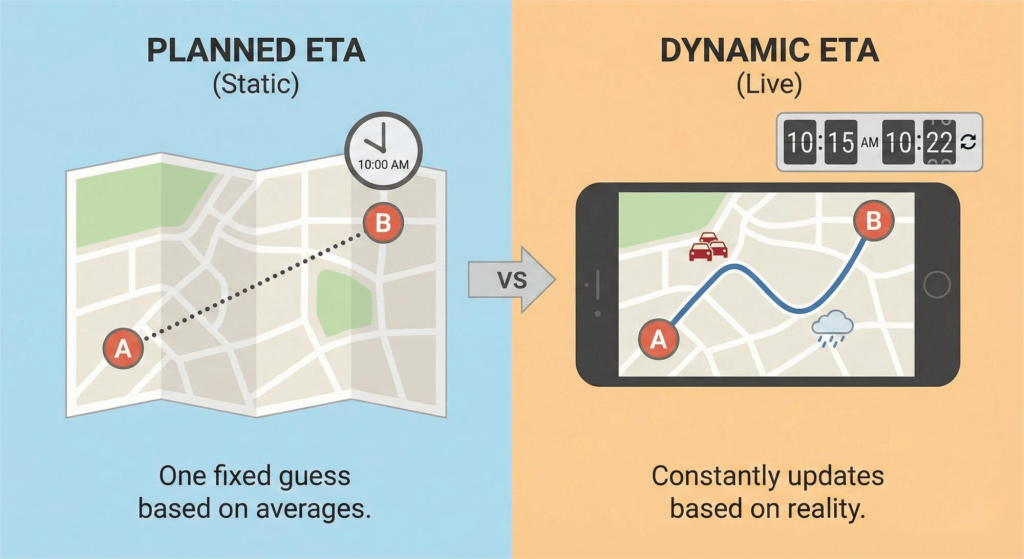
There are actually two kinds of ETA in logistics: planned ETA and dynamic ETA.
Planned ETA is the usual estimate you get when an order first enters your system. It’s “calculated” using historical averages, standard transit times, carrier schedules, etc. The problem with planned ETAs is that they don’t change because they can’t track the current conditions during the shipping journey.
In contrast, dynamic ETAs work better with “changes”. These ETAs take advantage of real-time GPS, traffic patterns, weather reports, and operational signals (like dock dwell times and driver hours) collected as the shipment moves.
For example, let’s say a shipment is heading from California to Miami with a planned ETA of Friday at 3 PM. But there’s a typhoon approaching Florida that will impact inbound flights, and a major highway closure in Texas is causing unexpected ground-transport delays. A dynamic ETA adjusts to Monday at 11 AM, while the planned ETA still shows Friday at 3 PM.
How to Get an Accurate Estimated Time of Arrival
If you want to make dynamic ETAs even more accurate, real-time tracking can help.
By constantly monitoring a package’s exact location, the tracking system can detect delays or faster-than-expected progress along the route. For example, if a package is stuck in traffic or held at a hub, the ETA can be adjusted accordingly.
AI and machine learning take it even further. These technologies analyze past deliveries, real-time traffic, and operational data to detect patterns. This allows your businesses to predict potential delays before they happen, rather than just reacting to them.
Why Does Accurate Estimated Time of Arrival Matter
An accurate ETA can help you improve customer satisfaction, reduce failed deliveries, and optimize supply chain planning. Let’s discuss each one:
Improve Customer Satisfaction and Trust
Customers feel more satisfied when the estimated time they have been told matches when their order actually arrives. Over time, that kind of consistency makes the experience feel reliable, and they start seeing your store as a place they can buy from again.
Reduce Failed Deliveries and Costs
Reliable delivery timing directly improves first-attempt success. Customers know when to expect the driver, so they can plan their day around the delivery window. Fewer missed drop-offs allow drivers to avoid repeat visits and extra routes, reducing fuel costs. Carriers benefit too because their schedules stay intact instead of being pushed back by undeliverable parcels.
Optimize Supply Chain Planning
Internally, dynamic ETAs shift your team from reactive firefighting to proactive planning. By flagging potential delays hours or days in advance, the system enables management by exception. Instead of tracking the status of every single shipment, your team focuses only on the ones at risk: solving problems before they disrupt the supply chain.
Conclusion
Accurate ETAs help you reduce support inquiries, manage delivery expectations, and build loyalty with customers who know they can count on your delivery promises.
TrackingMore gives you real-time tracking updates from over 1,500 carriers, so you always know exactly where a package is.
By using the latest shipment data, you can provide ETAs that reflect the current status of each delivery rather than estimates based on outdated information.
Ready to get more accurate ETAs? Start your 14-day free trial with TrackingMore.
FAQs about ETA
ETA means “estimated time of arrival.” It’s the projected time when you can expect a shipment to reach its final destination.
You can use ETA to let customers know when their orders are likely to arrive, so they have a clear idea of when to expect the delivery. It’s also used within the logistics flow to track when a shipment will reach a local hub or port, which helps teams prepare for the last-mile delivery stage and manage handoffs without delays.
You can calculate ETA manually by dividing the distance by speed, then adding time for stops or delays. Or, you could use a free ETA calculator for a quick estimate. But if you need accurate ETAs, it’s best to use an advanced tracking solution or build one in-house with AI and machine learning.
The main difference is what each timestamp refers to in the shipment’s timeline.
– ETA (estimated time of arrival) is the expected time your shipment will reach its destination.
– ETD (estimated time of departure) is the projected time of when the shipment leaves a warehouse, port, or facility.
– ETC (estimated time of completion) tells you how long a shipment or task, like loading, unloading, or customs clearance, takes.
The TrackingMore team shares insights on logistics tracking technology, industry trends, and e-commerce logistics solutions to help businesses streamline shipment tracking and enhance customer post-purchase experience.