Once an order leaves the warehouse, customers start asking the real delivery questions: Where is it now? When will it arrive?
Basic tracking can answer some of those questions, but it isn’t always enough when updates are delayed or deliveries do not go as planned.
For ecommerce businesses managing large volumes of shipments, those gaps make it harder to keep track of what is happening across orders and manage customers’ expectations.
Shipment visibility helps fill in those gaps by giving businesses nearly real-time visibility of delivery activity after an order ships.
In this article, we’ll look at what shipment visibility means, how it differs from shipment tracking, and why it matters in ecommerce logistics.
What Is Shipment Visibility?
Shipment visibility refers to the ability to track and monitor shipments throughout the delivery journey with nearly real-time visibility into their status, movement, and progress.
At its simplest, it means teams are not limited to a package’s last scan. They can see how delivery is unfolding, whether timing is starting to slip, and whether a shipment may need attention before the problem becomes obvious.
In practice, shipment visibility includes:
- Timely updates from multiple data sources.
- Predictive ETAs powered by machine learning.
- Exception detection to flag delays automatically.
- Operational insights that help teams stay ahead of potential disruptions.
Shipment Tracking vs Shipment Visibility
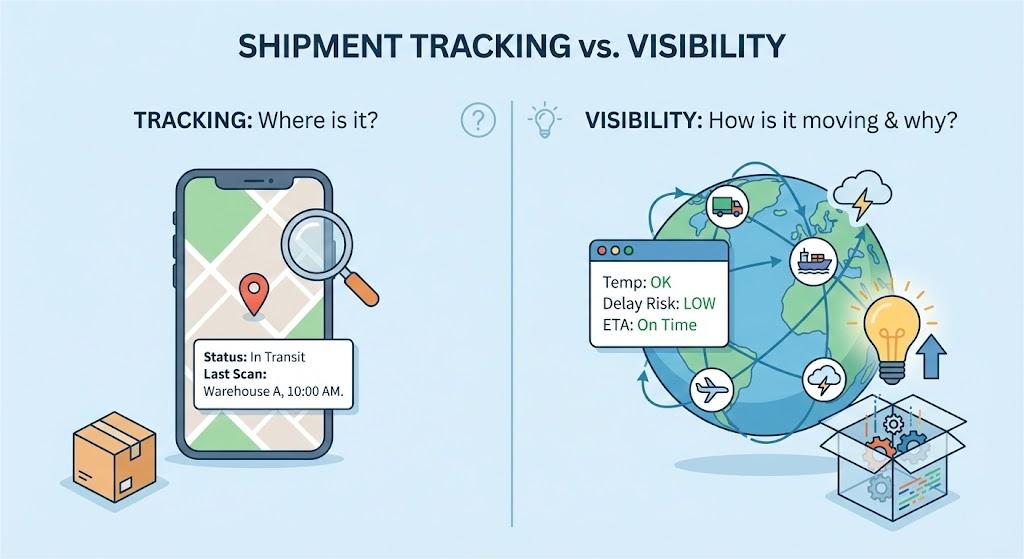
One main thing you need to know is this: tracking tells you where a shipment is, while visibility shows whether it’s on track and what to do next.
Shipment Tracking
Shipment tracking provides shipping updates based on carrier scan events. They are shown as basic statuses like in transit, out for delivery, or delivered, along with the shipment’s latest location.
Basic tracking is enough for simple order follow-ups. Customers can manually enter a tracking number to see where a package is, while support teams can use the same information to respond to common delivery questions.
However, tracking has clear limits. Because it only shows what has already happened, it is less useful for logistics operations teams that need early warning signs and enough lead time to respond.
Shipment Visibility
Shipment visibility goes beyond basic tracking by adding context, predictive insights, and a more connected view of what is happening across the supply chain after an order ships.
Instead of only showing the latest tracking event, it helps teams understand whether a shipment is moving as expected, whether the ETA still looks realistic, and whether an exception may already be developing.
For example, a shipment may still appear to be in transit, but shipment visibility tools can show that it has been sitting too long at one checkpoint or falling behind its expected timeline.
For teams managing a high volume of shipments, that level of centralized visibility makes it easier to monitor orders at scale, catch issues earlier, and respond before delays turn into customer or operational problems.
Key Components of Shipment Visibility
Shipment visibility is not built on a single feature. It depends on several layers working together, from how shipment data is structured to how teams interpret and act on it.
1. Standardized Carrier Data
Shipment data does not come in a clean, consistent format.
Different carriers report updates in different ways. They use different status names, different event structures, and sometimes very different levels of detail for the same stage of delivery. That makes it difficult to compare shipments or understand what is really happening across orders.
Shipping visibility starts by making that data usable.
Updates from different carriers are mapped into a more consistent structure, similar events are grouped together, and key fields such as timestamps, locations, and tracking numbers are standardized. This makes it possible to read shipment data across carriers without having to interpret each one separately.
Without this layer, everything else—ETA updates, delay detection, and workflow automation—becomes unreliable.
2. Shipment Signals and Delivery Insights
Once the real-time data is consistent, the next step is understanding what it shows.
Shipment signals come from carrier events such as scans, checkpoint movements, and delivery milestones. On their own, these updates show where a shipment has been. But when read over time, they also reveal whether the delivery is unfolding normally.
As new events arrive, ETA can shift, and patterns in movement can point to potential delays. A shipment that stays too long at one location, or fails to move to the next stage when expected, often signals a problem before it is officially labeled as one.
For example, an international order that has not left a sorting hub for several days may already be at risk, even if the status has not changed yet.
3. Exception Management and Response Workflows
Identifying a potential issue is only part of the process. Teams also need to decide what to do next.
Exception management focuses on turning those signals into actions. When a shipment shows signs of delay, failed delivery, or abnormal movement, it should trigger a clear response instead of being left as a passive update.
That response can take different forms depending on the situation. A delayed shipment might need internal review. A failed delivery attempt might require the customer to confirm details. A shipment that has stopped moving may need to be flagged for investigation.
In other words, shipping visibility is only useful if it leads to a response. Seeing a problem matters, but acting on it is what changes the outcome.
4. Customer-Facing Tracking Experience
Shipment visibility is not only for internal use. It also shapes what customers see after an order ships.
Most customers are not looking for detailed tracking data. They want clear answers: where the order is, whether it is still moving, and what changed if something goes wrong.
A well-designed tracking page helps by presenting shipment progress in a way that is easy to follow. Proactive notifications can keep customers informed and reduce the need for customers to check repeatedly, especially when delivery timelines change.
This can not only improve customer satisfaction, but also reduce the ticket pressure of the support team.
Why Shipment Visibility Matters for E-commerce Logistics
Once an order ships, the work is not over for the brand. Customers still want updates, support teams still need answers, and operations teams still need to know when something starts to go wrong.
Reduce WISMO and Support Tickets
As order volume grows, “Where is my order?” questions usually grow with it, especially during peak seasons and campaign periods.
The problem is not always that shipment data is missing. More often, the available update does not answer the real question. Customers want to know whether the order is still moving, whether it is delayed, and whether they should expect a change.
Shipment visibility helps reduce those inquiries by making shipment progress easier to understand and easier to communicate. Teams can spot changes earlier, and customers can get more useful updates through notifications and branded tracking pages instead of reaching out to support for answers.
Improve Delivery Confidence and Customer Experience
A lot of delivery frustration comes from uncertainty, not just the delay itself.
If a customer is expecting an order on March 30 but the tracking page still only shows in transit on March 29, that lack of clarity can quickly weaken confidence in the delivery experience.
Shipment visibility helps close that gap by giving brands a better way to share updates when delivery timelines change or exceptions appear. Customers get a clearer sense of what is happening, and that makes the post-purchase experience feel more reliable even when delivery does not go exactly as planned.
Better Control and Efficiency in Operations
For ecommerce businesses that want to improve operational efficiency, they have to see the patterns that affect delivery performance. But that won’t be easy if teams have to review each shipment one by one just to understand what’s happening.
With a shipment visibility platform, data becomes more consistent and easier to compare between shipments and deliveries. Logistics teams will be able to make better decisions based on data. That means choosing better carriers, adjusting routes, and making predictive analytics in the process.
Over time, this gives teams a strategic advantage in supply chain management. It supports better cost efficiency and helps keep supply chain operations consistent as shipment volume grows.
How to Integrate Shipment Visibility
Teams usually add shipment visibility in one of three ways, depending on how they want shipment data to flow into their systems. The right setup can also support broader supply chain visibility by making shipment data easier to access, share, and act on across teams.
Tracking APIs are useful when data needs to be pulled on demand. For example, a support tool might request the latest shipment status when an agent opens a ticket, or an internal system might check milestones and ETA at scheduled times.
Webhooks are a better fit when updates need to be pushed automatically. As new shipment events come in, they can trigger customer notifications, internal alerts, or follow-up workflows without requiring a manual check each time.
For teams that want a faster setup, ready-to-use tools can be the simplest starting point. Dashboards, platform apps, and prebuilt integrations make it easier to launch shipment visibility without building every workflow from scratch.
For example, a team might use a Shopify app to add tracking updates to the post-purchase customer experience, or rely on a dashboard to monitor delayed shipments without setting up custom internal tools first.
Improve Shipment Visibility with TrackingMore
TrackingMore brings together tracking data from 1,500+ carriers and 90+ airlines, making it easier for teams to work with more consistent shipment data across different carriers and markets.
For teams looking for a practical way to improve their visibility across shipments, TrackingMore offers several shipment visibility solutions.
It supports shipment tracking APIs and webhooks for seamless integration, along with tools such as a Shopify order tracking app and an admin dashboard for faster setup.
That gives teams flexibility: they can build custom workflows where needed, while still using the dashboard for everyday tasks such as monitoring shipments, reviewing delivery issues, and handling bulk updates through CSV import and export.
TrackingMore also supports enterprise needs with service level agreements, 24/7 customer support, and GDPR compliance.
Ready to move beyond basic tracking? TrackingMore supports both fast setup and custom integration for teams building shipment visibility into their workflows.
FAQs about Shipment Visibility
Shipment visibility is the ability to track and understand what’s happening throughout a shipment’s journey in near real time after it leaves the warehouse. It includes updated delivery timelines and early signals of delays, so teams can act on issues and share clearer, more accurate updates with customers.
Shipment tracking shows the latest carrier-reported status and location. Shipment visibility goes further by helping teams judge whether the shipment is still moving normally and whether a delay or exception may be developing.
In ecommerce logistics, real-time shipment visibility usually means a real-time view of shipment activity as new carrier data becomes available through scans, APIs, and related integrations.
Shipment visibility reduces WISMO tickets by giving customers clearer, timely updates they can check on their own. With features like branded tracking pages and proactive notifications, customers don’t need to reach out just to ask for status.
The TrackingMore team shares insights on logistics tracking technology, industry trends, and e-commerce logistics solutions to help businesses streamline shipment tracking and enhance customer post-purchase experience.