Last-mile delivery is the most expensive part of ecommerce logistics. According to Statista’s data, its share of total shipping costs went up from 41% in 2018 to 53% in 2023.
Despite these rising costs, customers place more weight on this final delivery stage. Delivery cost and speed are now part of what customers consider in their overall shopping experience.
If merchants can’t keep up with these expectations, the impact can hurt their brand reputation and reduce repeat purchases.
In this article, we’ll talk about last-mile delivery challenges in detail and how you can solve them to improve efficiency and control costs.
Why is Last-Mile Delivery Important in eCommerce?
Last-mile delivery is the trickiest part of ecommerce logistics. Couriers must deliver each parcel to individual recipients, often under tight time constraints and unpredictable conditions. This challenge increases operational complexity and delivery costs.
At the same time, this is the stage where customers are most involved.
According to Sifted’s 2025 Consumer Survey, 48% of customers say a poor delivery experience makes them less likely to buy from a brand again.

They expect to receive their package as fast as possible and also get complete visibility during the delivery.
If you fail at meeting those expectations, customers start to lose confidence in your brand. That poor delivery experience is enough to lose some of them forever.
But by focusing on building effective last-mile delivery, you can manage high shipping costs, improve delivery efficiency, and increase customer loyalty.
Key Challenges in Last-Mile Delivery
Last-mile delivery presents key challenges that directly affect timelines, costs, and the customer experience. These include route inefficiencies, lack of shipment visibility, failed deliveries, and higher customer expectations.
Inefficient Route Planning
Poor route planning is one of the main reasons why delayed deliveries happen in the last mile. One small issue on a fixed route can affect the whole delivery schedule for the day.
We know that seasoned manual planners are important for your operations. But even the best ones won’t be able to provide an accurate real-time route. That’s because factors like traffic conditions, weather, and road closures are unpredictable.
For example, when drivers run into emergency road repairs, they have to adjust and decide on their own. They may take longer routes or skip affected destinations. Another option is to move certain deliveries to the end and return to them later.
But whichever option the driver chooses, those changes can result in more fuel used and higher delivery costs.
Lack of Real-Time Visibility
Last-mile logistics often become harder to control when package status is lost during handoffs or delivery exceptions. Neither your teams nor customers have a clear picture of the current delivery process and what’s causing the delay.
Customers’ moods can be largely affected by a lack of real-time updates. Of course, they want to know where their package is and whether the shown estimated time of arrival (ETA) is still accurate. When that information isn’t available, they become anxious and frustrated.
To ease their concerns, they reach out to your customer support. This puts a lot of pressure on your team as they have to manually check multiple carrier sites to track down updates.
The High Cost of Failed Deliveries
Another last-mile delivery problem is failed deliveries. It usually happens when no one’s home or the customer refuses to accept the package. But wrong addresses, access restrictions, and unexpected weather changes can also cause it.
The problem with failed deliveries is what follows. The courier has to adjust the route, bring the package back to a local facility, and plan another delivery attempt.
That second attempt often comes with many of the same costs as the first one. In some cases, carriers even charge additional fees for re-delivery or short-term storage.
But that’s not all. Sometimes schedules are already tight, and that pushes delivery times further. Customers may have to wait a few more days to receive the package, which badly affects the customer experience. If you fail to lessen failed deliveries, you can lose customers in the process.
Increasing Customer Expectations
According to RetailEconomics’ 2025 delivery benchmark report, there have been slight changes in customers’ delivery expectations.
Cost is still the top priority for customers (33%), even though its importance went down a bit from last year. Meanwhile, delivery speed and convenience, such as flexible delivery locations or time slots, remained close together and ranked second (23%) and third (17%).
There’s also growing attention on delivery visibility and tracking. Customers who prioritize tracking increased from 9% last year to 11% this year. Since customers are now becoming more cautious, they expect consistent updates throughout the delivery process.
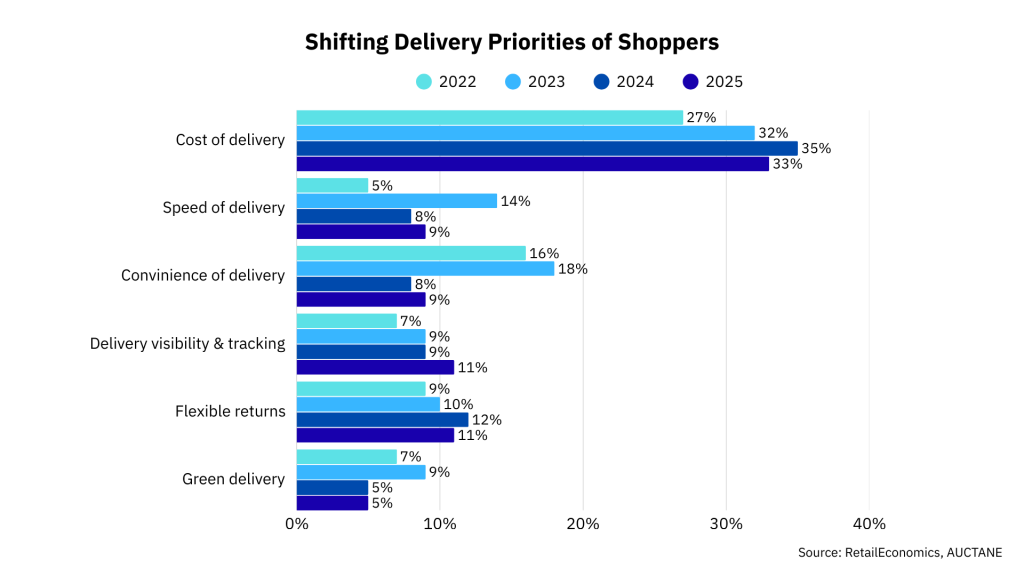
There’s no doubt that customers now place more value on their experience. They want a fast, convenient, and flexible delivery, not just standard delivery.
So, those are the common problems in last-mile delivery. You have to pay close attention to this final stage if you don’t want to drive up your costs and lose customers. The good news is that there are different ways to address these challenges. And that’s what we’ll talk about next.
How to Solve Last-Mile Delivery Challenges
To overcome these challenges, here are four proven approaches to improve last-mile delivery performance.
1. Implement Last-mile Delivery Software
One of the most effective ways to tackle inefficient routes and reduce failed deliveries is by using last-mile delivery software. The software centralizes essential delivery data, such as order details, addresses, driver availability, vehicle capacity, and delivery windows, so your team can plan and manage deliveries more efficiently.
Unlike manual planning, last-mile software can automatically optimize routes and adjust schedules on the fly. If drivers encounter traffic, weather delays, or road closures, the system recalculates the best path, which helps avoid unnecessary detours.
By streamlining operations, businesses can improve delivery speed, reduce labor and fuel expenses, and prevent delays caused by poor route planning or last-minute changes.
You may be interested in:
Best Last-mile Delivery Software in 2026
2. Integrate with Real-time Tracking System
A real-time tracking system gives full visibility for both you and your customers.
By integrating it with your store, you can track all your orders in one dashboard. To keep customers informed, you can send notifications to them automatically. You can also build an order tracking page that lets your customers check their order statuses.
Real-time tracking also helps your team respond quickly to exceptions, such as failed deliveries or delays, and gather data to continuously improve last-mile operations.
For example, you can analyze historical shipment tracking data to see which delivery routes or shipping partners consistently meet deadlines and which tend to cause delays.
3. Adopt Smart Lockers and Pickup Points
Smart lockers and PUDO (pick-up and drop-off) points are becoming popular solutions for failed deliveries.
With this last-mile delivery service, parcels are dropped off at secure lockers or staffed partner locations like convenience stores or carrier counters. Once the package arrives, customers receive a code or notification and can pick it up at a time that works for them.
This is so important because customers are more likely to choose retailers that offer greater delivery flexibility. With alternative pickup locations, they are no longer tied to a specific delivery window or worried about missing a driver.
This flexibility can help your brand stand out from competitors and reduce shopping cart abandonment.
It also changes how delivery routes work. By dropping off multiple packages at a single location, drivers can reduce the number of stops they need to make. Routes become easier to plan, and there’s less time lost on waiting or repeated attempts.
4. Set up a Dark Store for Faster Deliveries
No matter how fast your delivery service is, the distance from the warehouse to customers can still slow down order fulfillment.
To keep up, businesses are setting up dark stores. They are retail locations or small warehouses in high-demand areas used only to fulfill online orders. You can store inventory, pick items, pack orders, and hand them off for delivery or pickup from this place.
Because orders are prepared closer to the final destination, drivers spend less time traveling across the city. Routes stay shorter, so offering same-day or next-day delivery becomes possible.
Conclusion
There’ll be more and more last-mile challenges in the future. But the core issue will remain the same: how to deal with increasing customer expectations.
Today, your customers expect more delivery options than ever before. They want the freedom to choose same-day or next-day delivery, flexible pickup locations, or pay higher fees for premium services such as furniture delivery with in-home installation.
But fortunately, AI is now reshaping the entire ecommerce industry. You might have already started experimenting with it to make your operations more efficient.
But do you really know where customers actually want AI to step in?
The answer may surprise you. Most are far more receptive to AI in the post-purchase and delivery stages than before they even make a purchase.
That’s why you might focus on using AI to power real-time tracking, proactive delivery updates, and a more convenient returns process.
Ready to take your customer delivery experience to the next level?
At TrackingMore, we help retailers like you streamline operations, reduce delivery issues, and help your customers enjoy a hassle-free post-purchase experience with every delivery.
Easton has 3 years of experience researching and writing about e-commerce and logistics. She enjoys sharing the latest industry trends and insights with readers.